
On the Gas, No Map OR All Map, No Gas?
Should startups focus on going fast with minimal or no planning, or plan to make sure they get it right?
The obvious answer is go fast right? Let’s think about that.
While looking at any business situation or problem, it’s interesting sometimes to go to ridiculous extremes and work your way back to practicality and solutions based on wisdom and evidence. A situation I’ve often encountered is counseling business leaders on the speed vs quality dilemma.

The principles of Lean Thinking address this as the Devils Triangle – The inevitable tradeoff between time, cost, and quality of business operations. Every organization has a complex and unique set of relationships between these three factors, and leaders have three metaphorical levers they can use to assert control over the organization.

Typically, speeding up a process will increase costs and reduce quality. Reducing Costs will slow down the process and/or reduce quality, and while attempting to increase quality will increase costs and reduce speed.
Experienced leaders, in mature organizations that are approaching excellence, have a deep understanding of these complex interactions and hence can make evidence-based adjustments using data from existing systems. In a startups however, there are too many unknowns in the evolving business, business systems are still being established and change in the business environment is constant.
This article addresses how startup founders can apply Lean principles to find the sweet-spot of balancing speed – generally a powerful driver for a startup, cost – always a constraint for startups, and quality – keeping mistakes, defects, complaints, rework in control by understanding the costs of poor quality (COPQ).
Primarily we addresses the metaphorical choice faced by startup founders; Which lever do I push?
Speed Lever – On the gas! No Map – Best expressed as the “Move fast and break things” philosophy of Facebook in the early days, and others who say get to market at all costs.
Quality Lever – All Map, No Gas – Incessant planning, strategy, and study that stalls the business, never getting to market and never getting real customer feedback and traction.
Incidentally, Mark Zuckerberg qualified his “Move fast and break things” policy to include “Move fast with stable infrastructure”. This indicates that good quality systems have a place in the organization and recognizes that poor quality has a cost.
The Startup Dilemma
Startups must move fast, they must be agile, and always be prepared to pivot and re-strategize based on rapid changing situations. BUT they cannot grow and sustain growth without some form of planning. Action without planning is tantamount to making stuff up; Don’t make stuff up! A quote that stresses this in a more articulate manner is:
“Strategy without tactics is the slowest route to victory, and tactics without strategy is the noise before defeat.” – Sun Tsu – The Art of War.
So, to establish our continuum of extremes as discussed earlier, at one end, with all thinking, planning, and preparation and no action we are at a standstill, going nowhere. At the other end, with all action, and no planning we don’t know where we are going, chasing multiple opportunities and stimuli.
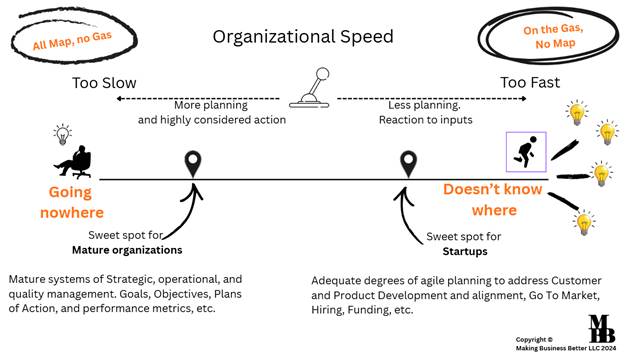
On the Gas, No Map
At this end, we celebrate the founders who “just shipped it.” No plan. No permission. No sleep. Strategy is for later. PowerPoint is for cowards. Action is everything. Heros if they get it right, but careless cowboys, open to criticism when they don’t.
All Map, No Gas
At the opposite end, we find founders and teams buried under frameworks, canvases, decks, roadmaps, and color-coded spreadsheets. The plan is immaculate. The logic is flawless. The execution… well, execution is still “under consideration.”
Both camps are convinced that the other one is doing it wrong, while both are right… and wrong.
The False Choice that Nobody Wins
The real problem isn’t speed versus planning. It’s mistaking action for progress and planning for certainty.
- Moving fast with no plan feels, and can even appear as heroic, but often turns into expensive learning that you didn’t need to pay for.
- Moving slow with excessive planning feels responsible but often becomes procrastination masquerading as rigor.
Startups don’t fail because they move too fast or too slow. They fail because their thinking is disconnected from their doing. They fail to establish a true measure of progress, so telling the team to go faster is pointless if they can’t tell see how fast they are going.
Camp 1: “No Plan, Just Action”
You know this founder. They pride themselves on velocity. Decisions are made in Slack, Zoom calls, and on the fly. Strategy happens in their head. Documentation is “waste.” The mantra is “we’ll figure it out as we go.”
To be fair, this approach has strengths:
- Fast feedback from the market
- High energy and momentum
- Less time spent debating hypotheticals and solving problems that haven’t occurred.
- Early signs of product-market fit (or lack thereof)
But here’s where it breaks down. Without any shared plan, even a lightweight one, everything depends on what the founder remembers, believes, or feels that week, or in the moment. Priorities shift. Teams guess, individuals do what they think is right or worse, they wait to be told what to do. Rework explodes, innovation stalls, gaps appear, and tensions rise.
Eventually, “moving fast” turns into:
- Rebuilding the same thing multiple times
- Confusing customers
- Burning cash with confidence
- Hiring smart people who can’t tell what “good” looks like
- Frustration and low morale
Speed without direction doesn’t make you agile. It makes you busy. If you find that you don’t have bandwidth, you are probably lacking a plan. Continuous activity isn’t continuous improvement, it’s waste that burns bandwidth of all team members.
Camp 2: “All Plan, No Action”
Then there’s the opposite extreme. This founder has a deck for everything. The vision is poetic. The strategy is defensible. The assumptions are footnoted. The plan has phases, gates, and dependencies. Execution, however, keeps slipping into the future. Milestones (if they exist) are missed and regularly reset. Common symptoms of this state include:
- “We’re not ready yet”
- “We need to be careful of…”
- “We need more analysis, data, feedback…”
- “Let’s validate that assumption again”
- “We’ll launch after the next planning cycle”
These are all valid talking points, but the irony is, most of this planning is an attempt to avoid risk in an environment that only rewards learning through action. At some point, planning stops reducing uncertainty and starts creating it because reality keeps changing while you’re polishing the model.
The perfect plan that never meets the market is just a fantasy.
The Real Answer: Just Enough Plan, Just Enough Action
High-performing startups don’t choose between planning and action, they establish a sweet spot, or Goldilocks point that binds together strategic thinking, documentation, communication, and action. They think of strategy not as a detailed map, or plan, but as a transparent articulation of:
- A clear direction and Vision that the team collectively understands
- A small number of explicit choices
- A coordinated set of short-term plans of action and milestones (POAMS)
- A shared understanding of what we’re trying to learn next moving us closer to our Vision.
In other words: Plan enough so action makes sense. Act enough so planning stays honest.
This is where the founder must lead. Establish an understanding of every issue, matter, or problem to be addressed. Keep them singular and simple to understand. Organize (quantify, prioritize) what you know into clear plans of action and milestones. Again, keep these simple, short-term, and always apply a simple check – “will this move us toward our vision?” then execute the plans.
Determine what measures your velocity and movement toward the vision. Understand and address risks but quantify and decide without over thinking. A risk is not an issue to be addressed until it occurs. Act according to a plan, avoid reaction to stimulus, add every new input to a plan of action. Typical examples of random stimulus that can distract you from the plans are:
- Potential customers, partners, investors etc. that appear as a “once in a lifetime opportunity”
- Take these in and handle them systematically as Leads, Opportunities, etc. Understand the opportunity, quantify and prioritize, then act accordingly IF it fits your strategy.
- The better and bigger you become, the more of these once in a lifetime opportunities will appear, learn how to manage them strategically as early as possible.
- Customers that request a new feature that will lead to a sale.
- Stay true to your Product Development Strategy – Go To Market quickly with what you plan.
- Stay true to your Customer development Strategy – Stay within your ideal customer profiles until you are ready.
- Investors that approach you for a quick decision to take a stake in your business
- If you are raising capital (or considering it) establish a Fundraise Strategy.
- As tempting as these random offers are, if they are not within your strategy think long and hard before pivoting away from your plans.
What “Just Enough Plan” Actually Looks Like
This isn’t a 60-page business plan or a three-year roadmap. It’s things like:
- A crisp problem statement that the team understands and agrees upon
- Think of this as a Mission Statement, an Elevator Pitch, and extended talking points about what the business does.
- A vision
- Where is the business trying to get to at some point in the future.
- The founders story and vision – The why of the business.
- A defined customer segment and ideal customer profile – not “everyone with a pulse”
- A value proposition you can explain verbally or in writing – without slides!
- 3–5 strategic priorities you’re saying “yes” to – and many more you’re saying “no” to
- Think of these as your current set of Policies or Mandates which can be created and evolved quickly and easily.
- Agreed upon processes and disciplines to stay true to the priorities and not react to every stimulus.
- Clear hypotheses that you are actively testing, will test, and why.
What will evolve from this lean approach is a Strategic Collection, at the beginning consider collecting these strategic elements:
- Mission and Vision
- How the startup defines its purpose, direction, and the future it wants to create.
- Value Proposition
- What value is being created, for whom, and why your approach is meaningfully different for each of your Products and Services
- Business Model & Revenue
- How the startup creates, delivers, and captures value – revenue streams, pricing, margins, etc.
- Guiding Principles
- General guidelines which set the foundation for how an organization will operate.
- Critical Success Factors
- Major items or issues that must be controlled to achieve one or more objectives.
If your team can’t answer why you’re doing something in one or two sentences, you’re not moving fast, you’re just moving. If you are moving and you don’t know where you are (your current state) AND where you are going (your desired future state) why are you moving?
At the earliest stage of the business, produce and maintain these evolving strategic elements as completely and transparently as practical. As strategies evolve consider the use of a Strategic Elements Current State (SECS) page or document, a very simple collection of the strategies and policies as of today. This approach helps the team keep up with change of priorities, and enables team discussions to ensure deep understanding.
The power of the “just enough plan”, like more comprehensive plans, is not in the resulting plan, but in the strategic acting, learning, and thinking (SALT) that takes place in arriving at the documented strategies. As the leader, the founder, should make it a team sport, not a solo exercise. Of course, you have your vision, and you can probably think well beyond where most of the team are, but bring them all into the thinking, they will learn, you will learn, and you will instill a strategic mindset into the culture of your business.
What “Just Enough Action” Looks Like
Likewise, action doesn’t mean uncoordinated activity and chaos. It means:
- Small, deliberate experiments
- Short cycles of:
- Building à Testing à Learning
- Understanding à Organizing à Action
- Shipping things that deliver required value (Advantages and Benefits), not just more features
- Strategic pauses to collect evidence and reflect on what worked and what didn’t
- Current state review – Where are we?
- Speed and direction toward the vision – Are we heading in the right direction at the right pace?
Action without learning is just movement. Learning without action is just theory. Startups need both, with managed iteration.
A Simple Litmus Test for Founders
Discuss with your team:
- Are we moving fast because we’re clear – or because we’re avoiding deep thinking?
- Are we planning carefully because it adds focus – or because it feels safer than committing to action?
- Can the team articulate our current strategies without asking me first? – Is it written down, up to date, and easily accessible?
- Do we regularly pause to review our thinking based on what we’ve learned?
If the answers make you uncomfortable, well done! – you’re paying attention. 😊
Final Thought: Formulate a Customer Centric Strategy
Strategy is a noun; it is the force that drives the organization in a particular direction. Strategic Planning is a verb, it is the work of thinking, creating and refining the strategy to focus on the vision, and the work to be done to achieve that vision. Without this drive and focus your startup will get stuck, either where it is without the drive to move forward, or at some unknown state when you look up and don’t know where you are.
One mistake I’ve observed founders making is treating strategy either as storytelling, expecting everyone else to fully understand their vision as it evolves, or as a set of disparate documents, none of which conveys the way forward.
Successful founders recognize strategic planning as a practice, a discipline that is instilled in the team. Strategy isn’t something you finish and then execute, it’s something you continually refine through action, review, and adjustment, and you do it in the normal course of business.
Secondly, many startup strategies are product or technology centric, but it’s customers, not the business, that defines the value of your product or service. Without customers, the startup will fail. Failing to recognize the simple principle of “Customer Focus” is a cause of failure in many startups.
Customer Development must lead Product development. Startups are more likely to fail because they lack Customers and a proven revenue model than the lack of a product, so make sure your product is always answering the voice of the customer, and use your Customer Development Strategy to influence the customers thinking toward your product aiming for a model that pulls you toward the customer, and not pushes your proposition to the customer
The goal isn’t to be the fastest startup or the smartest planner. The goal is learn faster than you burn. Understand the customer’s needs, their pain-points, and what delights them. Solve their problems, and deliver value to their definition, not yours.
Move fast, but don’t do it blind. Plan carefully, but not obsessively, talk to your customers, know who your customers are individually, and collectively.
The startups that survive and grow aren’t the ones with no plan or those with the perfect plan. They’re the ones who continually think and take strategic action and clearly communicate as a team…without fooling themselves about progress.
___
Making Business Better – MBBcc.com is a coaching, advisory, and consulting practice, working with individuals and teams seeking personal and business excellence. Our mission is to help businesses become:
- Strategy Driven
- Process Managed
- Focused on Excellence
What does better mean for you? Schedule a FREE Consultation – MBBcc.com/discussion