
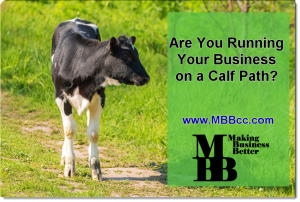
The Calf Path, written by Sam Walter Foss, tells the story of a calf wandering home through the woods one day, leaving a crooked, aimless trail behind it. A dog follows the trail the next day. Then sheep. Then people. Within a few generations, the trail has become a lane. The lane becomes a road. The road becomes a city street. Eventually, a major metropolis organizes itself around a thoroughfare that began as one confused calf’s walk home.
The poem’s final stanza lands the punch:
“For men are prone to go it blind
Along the calf-paths of the mind,
And work away from sun to sun
To do what other men have done.”
Sound familiar? At the end of this article is a link to the original poem, or read on to see how this metaphor applies to you and your business.
The Trail Is Everywhere
Calf paths don’t announce themselves. They show up as process maps nobody questions, approval chains that loop through three departments before landing back where they started, tools kept in service because “that’s what we use,” and meetings that exist because they’ve always existed.
Every business has them. The more successful the business, the more entrenched they tend to be — because success makes it easy to confuse what worked once with what works.
Here’s how it typically unfolds:
Stage 1 — Someone does something a particular way. Not because it’s the best way. Because it was convenient, or fast, or the only option available at the time.
Stage 2 — Others follow. No analysis. The path is there, it seems to work, so people use it. Nobody asks why it bends where it does.
Stage 3 — The path becomes infrastructure. Now there are tools built around it, training materials written for it, job descriptions that assume it. Changing it feels expensive.
Stage 4 — The infrastructure becomes culture. “This is how we do things here.” The original reason — if there ever was a good one — is long forgotten. The path itself is the reason now.
Stage 5 — The cost becomes invisible. Like the horse traveling three miles to cover one, everyone just accepts the extra effort as normal. Nobody calculates what it’s actually costing.
This is how you end up with a rational, modern business running on a three-hundred-year-old calf path.
The Problem Isn’t Laziness
It would be easy to blame this on complacency, but that’s too simple. Most of the people following a calf path are working hard. The horse in Foss’s poem is toiling beneath a burning sun. The effort is real. The problem is the direction.
The deeper issue is that established process feels like wisdom. When something has survived long enough, we extend it a kind of credibility it may not have earned. “We tried something different once and it didn’t work” becomes sufficient justification for never trying again. Precedent substitutes for thinking.
For founders and small business owners, this is particularly dangerous because your calf paths tend to be invisible to you. You built them. You remember when they made sense. It’s much harder to see the bends from inside the trail than from outside it.
How to Find Your Calf Paths
The question to ask about any process, system, or habit in your business is not “does it work?” It’s “why does it work this way?”
If the best answer anyone can produce is some version of “that’s how we’ve always done it” — you’ve found a calf path.
A few places worth looking:
Approval and sign-off chains. Who has to touch something before it moves? Map it. Then ask whether each hand-off adds value or just adds time.
Customer-facing processes. Your customers experience your calf paths more directly than you do. If your sales process, onboarding, or support workflow feels convoluted to them, it probably is — and the reason is usually internal, not external.
Regular meetings and reports. Ask when each one started and what decision it was originally designed to support. If that decision is long made, or the meeting no longer connects to any action, the path has outlived its purpose.
Tools and vendors. Contracts that auto-renew. Software nobody champions but nobody cancels. Suppliers kept out of relationship rather than performance.
Org structure. Reporting lines that reflect an older version of the business. Teams organized around how the company was rather than what the company needs to do.
Understand Before You Reorganize
There’s an important caveat here. Not every old path is a bad path. Some things have survived because they genuinely work. The goal isn’t to burn the process map — it’s to be intentional about what you keep.
This is where Understand → Organize → Act matters. The instinct when you spot a calf path is often to act immediately: cut the process, restructure the team, switch the tool. But acting before you understand the full picture is how you end up creating new calf paths to replace the old ones.
Start by understanding why the path exists and what it actually costs — in time, money, friction, and missed opportunity. That analysis usually tells you quickly whether you’re looking at a genuine problem or a feature that just looks odd from the outside.
Then organize your thinking: what would the direct route actually look like? What would need to change to make it viable? Who does this affect?
Then act. Deliberately, with a plan, not just a conviction that the old way was wrong.
The Question Worth Asking This Week
Somewhere in your business right now, there is a calf path. Probably more than one. A process that made sense once — or maybe never made sense — that has calcified into the way things are done.
The calf has been dead for three hundred years.
The question is whether you’re still following its trail.
Read The Calf Path by Sam Foss here
Making Business Better works with founders and small business owners who are ready to stop running hard in the wrong direction, taking every twist and turn. If you’d like to talk through what that looks like for your business, Contact Making Business Better